FEAR & GREED INDEX 45
Weekly Update
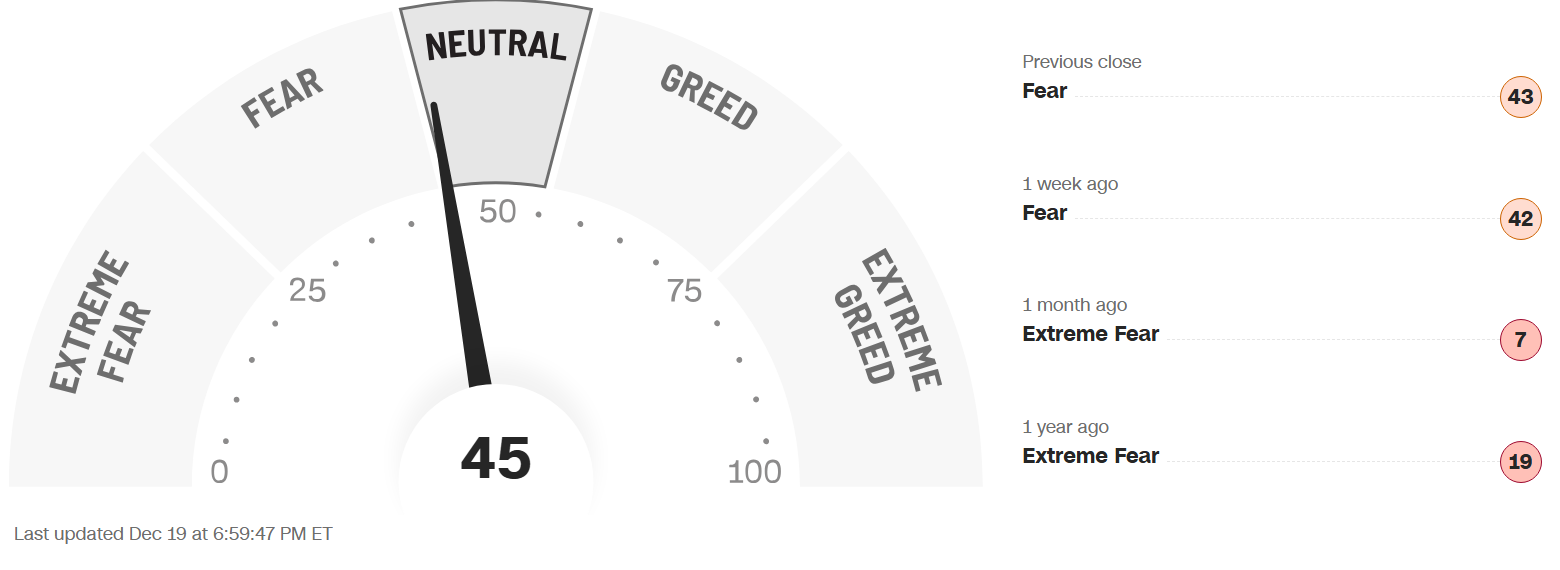
The Fear & Greed Index (found on cnn.com) is one of the easiest indicators to use to determine current market emotion. This simple to read gauge, highlighted in our publication When to Buy and When to Sell: Combining Easy Indicators, Charts, and Financial Astrology (available on Amazon), is measured in a range from 0-100, and currently reads 45 as of the close on Friday, December 19, 2025.
This figure moved just into the Neutral level, after rising 3 points from last week’s close of 42, as markets gradually rose late week. This was reflected in the S&P 500, as it rose 7 points, from 6,827 to 6,834, recovering from Wednesday’s large decline. There has been lower than average trading volume however, restricting any conviction of bullish or bearish movements.
Despite the oscillating price action, the 4 major indexes (S&P 500, Nasdaq, Dow Jones Industrial, and Russell 2000), continue their internal bullish sentiment regarding their 200-day moving averages. All remain in healthy high 50’s to low 60’s% range, with the DIA continuing to lead at 73%. Each index’ shorter-term 20 and 50-day MAs also remain in bullish territory, though the DIA has slipped of late. The seasonal strength of November and December (a month where fund managers alter their portfolios to buy leading stocks) has been mixed. The year-end bonus period for fund managers, the Santa Claus Rally, and Quarter-end window dressing remain in play as well, though it is getting late.
The “Risk-On” sentiment returned at weeks end, in the financial and technology sectors, which usually lead bull runs. 10-year bond yields remained stubborn, closing the week at 4.15% vs last week’s close of 4.19%, suggesting the bond market is not quite convinced that the economy is in good shape. Keep in mind that the recent rate cut was “priced-in” to the market, and the Fed Chair’s comments regarding future cuts was not very convincing.
The 7 internal factors used to formulate this gauge are listed on the screen (below):
Market Momentum – (S&P 500 vs its 125-day moving avg) = FEAR
Market Volatility (measured by the VIX) = NEUTRAL
Put to Call Ratio 5-day avg. (# of Puts (bearish) vs Calls (bullish) = EXTREME FEAR
Stock Price Strength (# of new 52-week highs vs new 52-week lows) = NEUTRAL
Stock Price Breadth (# of shares rising vs falling on NYSE) = FEAR
Safe-Haven Demand (which measures stocks vs bonds) = EXTREME GREED
Junk Bond Demand (non-govt. bond yield spread) = FEAR
This week 3 of these 7 factors changed levels, as collectively there is now no real directional bias to the equities markets. The markets internals remain a bit weak in the momentum categories, while volatility has subsided. The Put to Call Ratio has resumed its Extreme Fear sentiment, suggesting equities may be oversold, indicating a continuation of gains in the short term. Finally, Safe-Haven Demand, essentially commodities, has again reached the Extreme Greed level, signified by another surge in safer investments.
The VIX, measured by Market Volatility, dipped again, closing the week at 14.9, vs. last week’s close of 15.7, as market volatility continued to decline. The crucial “20” level, has not been approached since November 24, and, as noted last week, the gauge is now reaching low levels where a reversal is probable, though not likely until after the new year, unless a Black Swan event occurs.
News this week surrounded around the surprising dip in the CPI, a main measure of inflation. As noted, earnings season has basically come to a close with 3rd quarter growth of over 14% (when it was estimated around 7.2%), with higher-than-expected retail figures. Record high layoffs continue to weigh on the economy, however, as job creation, manufacturing, and real estate sales have all declined. These mixed results have resulted in neither a crash, or surge, in the equities markets thus far.
Astrologically, Sagittarius season (ruled by the planet Jupiter) ends today, December 21, and gives way to Capricorn season (ruled by the planet Saturn), through January 19. Please see our recent Sign Language – Capricorn blog, dated 12-5-25 for full details. As the Sagittarius/Jupiter optimism and expansion of Sagittarius season (usually resulting in favorable market conditions), have started to surface, they could be tempered by Saturn’s challenging energies.
The planet Mercury, will enter the sign of Capricorn on January 1 (through Jan 19), and is now weeks past its recent retrograde, which has resulted in lower volatility, as expected.
The planet Venus, which will enter the sign of Capricorn this Wednesday, Dec 24 (until Jan 16), exuded holiday cheer during its stay in Sagittarius, symbolizing the increase in retail spending. However, it has been noted that only the top 10% of the income earners are responsible for 50% of the spending activity, and the Capricorn/Saturn influence may temper that enthusiasm.
The planet Mars is also transiting the sign of Capricorn (Dec 14 – Jan 22), theoretically reducing over-aggression, and rewarding hard work and persistence. As previously noted, Mars in Sagittarius symbolized aggressive gains in the short-term, however, the recent square with the planet Saturn (which is now moving away) created a few challenges (please see our Trader Transits - Mars square Saturn blog, dated 11-29-25).
The planet Jupiter also remains retrograde in the sign of Cancer (until March 11). As previously discussed, Jupiter has very powerful expansive energies, which may weaken a bit for the time being.
Finally, the planet Uranus, which is currently in retrograde until early February, recently regressed from the sign of Gemini (communications and technology) to the sign of Taurus (money), and will not return to Gemini until April, 2026. This 6-month re-visit to the sign of money (ruled by Venus), could create more shocks to the markets, in either direction, so beware. Please review our Planet Power – Uranus Retrograde blog, dated 8-27-25 for further details.
Leading sectors, with over 50% of stocks trading over their 200-day MAs, included Financials (always needed for bullish moves), and Healthcare, while Consumer Discretionary improved, which is typical in the holiday season. Real Estate continues to be the laggard, though the additional rate cut may help turn the sector around. Utilities also fell heavily, with the decrease in bearish sentiment. Sectors of the technology industry that are likely to continue their advance into the future include AI, robotics, quantum computing, and space development (with Pluto positioned in Aquarius, and Uranus in Gemini for many years to come – when it returns in April), but will experience pullbacks along the way.
Gold (ruled by the Sun), and Silver (ruled by the Moon), rose again this week, especially silver, which has again hit all-time highs. The Gold to Silver Ratio (covered in our publication), declined again, closing at 64.3, compared to last week’s close of 69.4, suggesting gold is a better “value” buy at the current time. Both remain good buys after pullbacks (which they are due for) in the current economic conditions, as central banks continue to buy. Bitcoin (ruled by Uranus) remained steady this week after its recent large down move (in lock-step with the Uranus retrograde back into Taurus), but remains skittish.
***As always, this information is not intended to be financial advice, or any specific buy or sell recommendation, but rather a guide to assist the reader in some further understanding of current economic conditions/movements in the sky, and how they can affect moods, behaviors, world events, and financial markets.