FEAR & GREED INDEX 34
Weekly Update
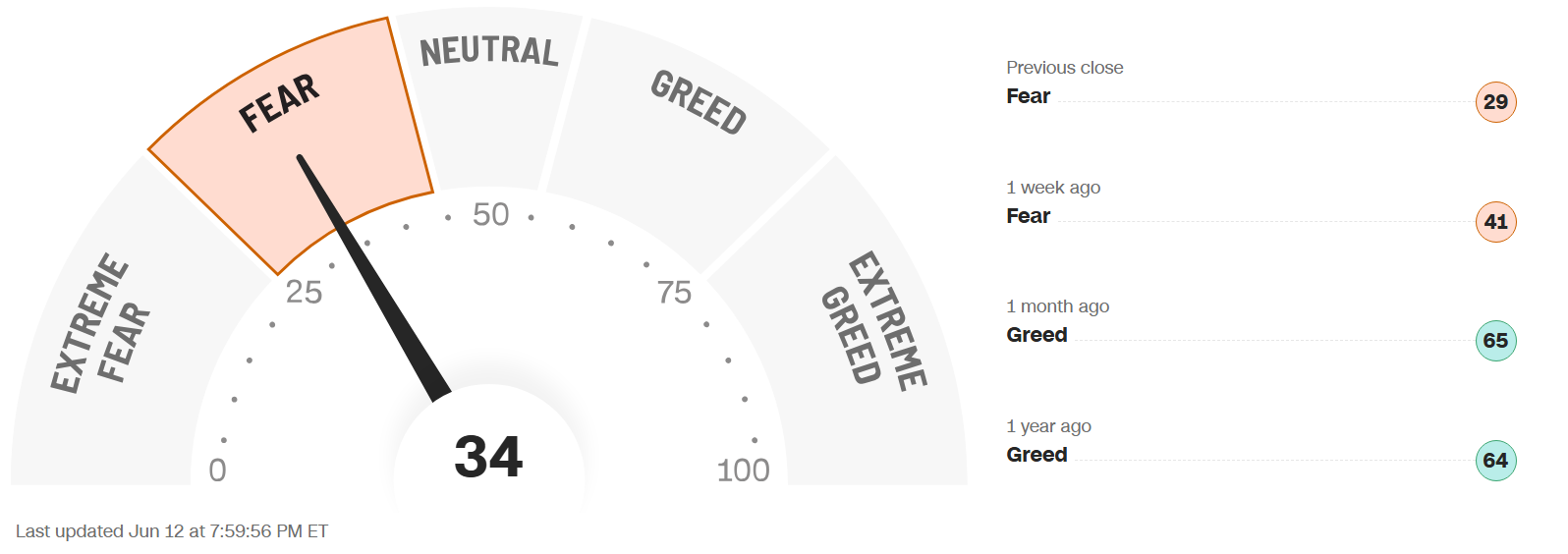
The Fear & Greed Index (found on cnn.com) is one of the easiest indicators to use to determine current market emotion. This simple to read gauge, highlighted in our publication When to Buy and When to Sell: Combining Easy Indicators, Charts, and Financial Astrology (available on Amazon), is measured in a range from 0-100, and currently reads 34 as of the close on Friday, June 12, 2026.
The gauge now sits in the mid-Fear category, decreasing 8 points from last week’s close of 42. This was a bit divergent from the S&P 500, which rose 48 points, from 7,383 to 7,431, in a week of expected volatility, where the gauge almost reached Extreme Fear on Wednesday.
The 4 major indexes’ 200-day MAs (Moving Averages) internal sentiment remains in the bullish zone, as the market broadened with pressure on technology prior to Thursday. The number of stocks making new highs on all indexes sits at 55%, led by the DJIA at 67%, while the shorter-term 20 and 50-day MAs are safely above the 50% mark.
The “Risk-On” sentiment slowly returned by weeks end, potentially ignited by the SPACEX (SPCX) IPO on Friday. 10-yr bond yields dipped slightly, to 4.48%, up from last week’s close of 4.54%, as uncertainty continues. Stagflation, when the economy is slowing and inflation is rising, again became a concern, as a rise in interest rates may be on the table.
The 7 internal factors used to formulate this gauge are listed on the screen (below):
Market Momentum – (S&P 500 vs its 125-day moving avg) = GREED
Market Volatility (measured by the VIX) = NEUTRAL
Put to Call Ratio 5-day avg. (# of Puts (bearish) vs Calls (bullish) = FEAR
Stock Price Strength (# of new 52-week highs vs new 52-week lows) = FEAR
Stock Price Breadth (# of shares rising vs falling on NYSE) = EXTREME FEAR
Safe-Haven Demand (which measures stocks vs bonds) = FEAR
Junk Bond Demand (non-govt. bond yield spread) = EXTREME FEAR
This week, 2 of these 7 factors changed levels, as Stock Price Breadth fell deeper, into the ExtremeFear level. The all-important Put to Call Ratio (used more by short-term traders) fell dramatically from Extreme Greed to Fear (we suggested a drop in last week’s blog) reflecting the change from over-enthusiasm to nervousness in the markets.
The VIX, measured by Market Volatility, moved downward by weeks end, closing 2.7 points lower at 17.7, vs last weeks close of 20.4, as the expected early June volatility continued, but calmed on Thursday and Friday. As we often note, any break-through of the crucial “20” mark suggests a pullback, which occurred last Friday, and early this week.
Energy prices declined this week with improved investor sentiment regarding an end, or at least better conditions, concerning the global military conflict. The much-anticipated SpaceX IPO, occurred on Friday, appearing to help boost technology, at least temporarily. The results were favorable, as the stock rose 19%, but remain cautious, to avoid getting caught in a bull-trap, if planning to invest. The vast majority of largely hyped IPO’s surge on the first day of trading, only to pull back significantly due to selling by early investors.
Economic data was steady this week, with manufacturing, housing, and even Consumer Sentiment showing improvement (for the first time in months). The inflation numbers, reflected by the CPI and PPI held steady, with a slight decline in the CORE (when food & energy are not counted).
Astrologically, we continue through Gemini season an air, 2-sided sign (May 21 – June 20), which is seasonally more volatile than Taurus. The expected drop in the VIX in Taurus season did develop, and, as indicated, picked up the pace through the first couple of weeks in June. Though Gemini season rarely suffers any major downturns, the gains are generally limited.
Mercury, the planet of trading, has now moved into the sign of Cancer, a water sign, (remaining for over 2 months until Aug 9), signifying a shift in mood and sentiment, also signifying increased market volatility. This transit is longer than usual for Mercury, highlighted by its next retrograde period in a couple of weeks.
The planet Venus ends its transit of the sign of Cancer this weekend, and now enters the sign of Leo (June 13 – July 9). During its stay in Cancer, it provided the expected shift to more “love of the home” stocks and sectors including cyber-security, and real estate/home improvement, which saw gains. It also coincided with a dip in cryptocurrencies since it exited Gemini, which had been favorable for that sector. Venus in Leo highlights fashion and self-pleasing products, signified by the Consumer Discretionary sector, which has been beaten down over the past several months, but would improve along with consumer sentiment.
The planet Mars continues its transit through the sign of Taurus (May 17 – June 28), cooling from its ultra-aggressive energies (in Aries) to more stable conditions. Mars in this sign tends to symbolize a lean toward longer-term plans (investments) rather than quick aggressive action. Mars is not favorable in the earth sign of Taurus, which has tempered the gains in Real Estate. Mars is also approaching a conjunction with the planet Uranus on July 4, which could provide more fireworks (pun intended). Please review our upcoming Trader Transits – Mars conjunct Uranus blog, in the next week, for further details.
As discussed heavily in recent months, Uranus (sudden, unexpected events/high technology) transits the sign of Gemini (communications, transportation) until 2033. Gemini, like Uranus, also represents high intelligence, communications, and technology, signifying major advances in those industries. Uranus’ energies have been on full display with quick, unexpected reversals, and do not be “surprised” if this type of market action continues with Mars approaching Uranus. As earlier noted, the two will form a conjunction on the 4th of July, suggesting high volatility just prior to, and after, that weekend date. Please also review our Trader Transits – Uranus in Gemini blog, dated 3-30-26, for more details.
Leading sectors continue to include Energy, which is heavily dependent on the ever-changing status of the Middle-East conflict,though it declined this week with oil’s drop. Real Estate continued to be solid, along with a rise in Consumer-related sectors. Financials have also improved of late, which is always a bullish sign. There has been some “sector rotation” after technology’s recent surge, which is better than money leaving the market or turning to bonds in a “flight-to-quality.”
As we continued to stress, sectors of the technology industry that are likely to continue their advance into the future include AI, robotics, quantum computing, and space development (recent surge), with both Pluto positioned in Aquarius and Uranus in Gemini, for many years to come, though they will experience pullbacks along the way.
Gold (ruled by the Sun), and Silver (ruled by the Moon), continued its slump this week, until Thursday morning, when it made a sudden reversal. The Gold to Silver Ratio closed at 62, down slightly (1.8 points) from last week’s close of 63.8, remaining rather neutral. As we continue to stress, both metals remain good buys after pullbacks, so long as central banks continue to buy, and Safe-Haven investments remain popular, which is expected. Bitcoin (ruled by Uranus) continues to struggle, with its Fear & Greed Index rising only slightly, to 19, remaining in ExtremeFear territory, ending 3 points higher from last week’s close of 16. Look for the second half of June to be better than the first.
***As always, this information is not intended to be financial advice, or any specific buy or sell recommendation, but rather a guide to assist the reader in some further understanding of current economic conditions/movements in the sky, and how they can affect moods, behaviors, world events, and financial markets.