FEAR & GREED INDEX 42
Weekly Update
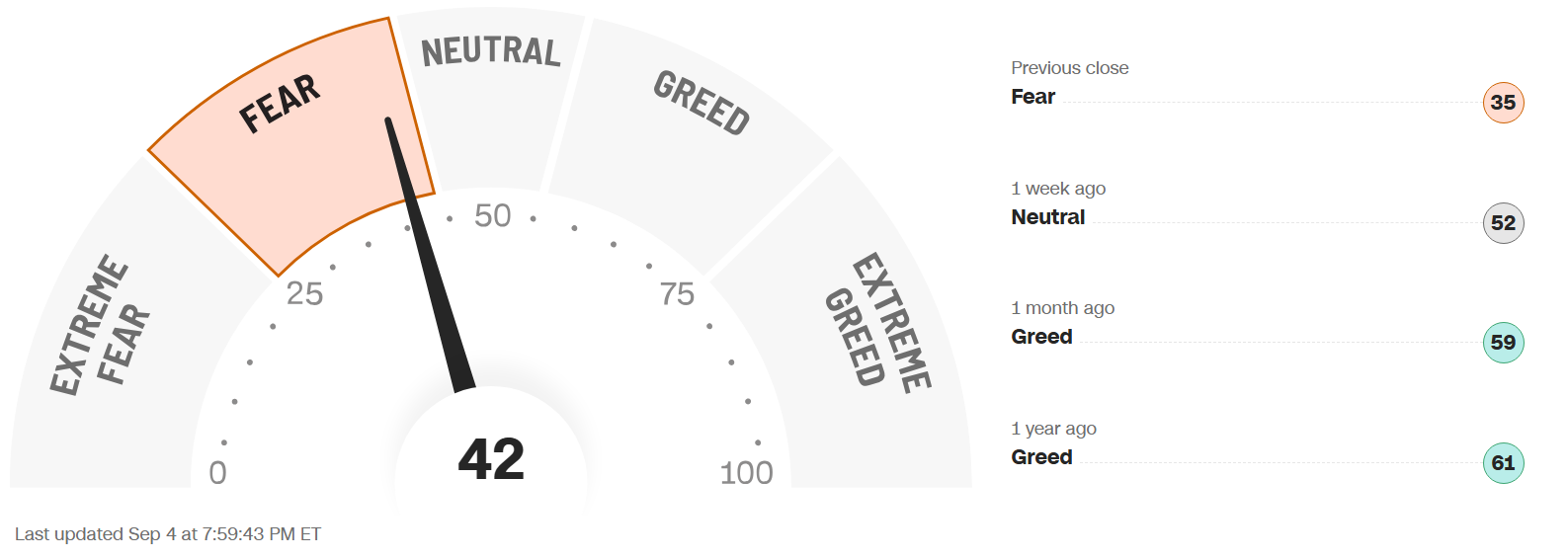
The Fear & Greed Index (found on cnn.com) is one of the easiest indicators to use to determine current market emotion. This simple to read gauge, highlighted in our publication When to Buy and When to Sell: Combining Easy Indicators, Charts, and Financial Astrology (available on Amazon), is measured in a range from 0-100, and currently reads 42 as of the close on Friday, September 4, 2026.
The gauge slipped back to the upper-Fear category, falling 12 points from last week’s close of 54, despite a slightly positive week, where the S&P 500, gained 7 points, from 7,711 to 7,718, powered by the Wednesday/Thursday rally.
The 7 internal factors used to formulate this gauge are listed on the screen (below):
Market Momentum – (S&P 500 vs its 125-day moving avg) = FEAR
Market Volatility (measured by the VIX) = NEUTRAL
Put to Call Ratio 5-day avg. (# of Puts (bearish) vs Calls (bullish) = NEUTRAL
Stock Price Strength (# of new 52-week highs vs new 52-week lows) = EXTREME FEAR
Stock Price Breadth (# of shares rising vs falling on NYSE) = NEUTRAL
Safe-Haven Demand (which measures stocks vs bonds) = FEAR
Junk Bond Demand (non-govt. bond yieldspread) = EXTREME GREED
This week, 3 of these 7 factors changed categories, with momentum categories remaining low. Stock Price Strength has now dipped into Extreme Fear level, while Market Momentum remains in Fear, suggesting all is not well with the underlying structure of the markets. The all-important, and wildly fluctuating, Put to Call Ratio finally ended at Neutral (for the first time in several weeks), though the intraday levels remained volatile. Overall, the market appears very fragile as we navigate through a weak seasonal period.
Moving Averages’ (MAs) bullish sentiment was mixed this week, with the longer-term 200-days remaining even at 57% (with the DJIA still leading at 67%). The shorter-term MAs dipped to 50% on the 50-day (vs 56% last week), though it rose slightly to 45% on the 20-day (vs 42% last week). Sectorstrength was fragmented this week, as recent leader Energy dipped, and laggard Utilities rose sharply, indicating the market is becoming more defensive. The only consistent at the time is Financials, which is a positive overall.
The “Risk-On” sentiment was also mixed as a result, as the market remains mainly indecisive. Though the VIX (market volatility), remained low, closing basically even at 14.5 vs last weeks close of 14.4, the low summer trading volume always begins to pick up after Labor Day. As we often note, however, any break-through of the crucial “20” mark suggests a pullback. Stubborn 10-yr bond yields remain elevated, rising 0.5 points, to 4.78%, from last week’s close of 4.73%, as interest rates remain at 19-year highs, which heeds caution.
Economic reports this week focused on increased jobs creation and manufacturing. Friday’s added jobs report was 3x higher than expected, at 162,000, resulting in the expectations of a Fed rate hike to climb again, putting pressure on the markets on Friday.
Astrologically, Virgo season continues through Sept 22. Virgo season is typically weak in the markets, with low confidence, a conservative approach, and higher volatility, as traders return from summer vacations, trading volume increases, and there are few catalysts after earnings season is complete. The last 2 years have been positive, however, bucking the trend of the past few decades. Major uncertainty persists in current market conditions, despite recent highs, which is not expected to change anytime soon, so proceed with caution. Please review our Sign Language – Virgo blog, dated 8-8-26 for more details.
Current shorter-term transits/aspects of note include the planet Venus transiting the sign of Libra through this Wednesday, Sept 9, signifying a fair, balanced, overall market in the short-term. The planet will move into the sign of Scorpio mid-week, however, which signifies increased volatility. The planet Mercury remains in the sign of Virgo (one of its 2 “home” signs) until Thursday, September 10, symbolizing more attention to specific fundamentals/reports. It will also change signs mid-week, transiting to Libra, signifying more balance and less harsh judgments. The communications sector has risen during this time frame, especially since Mercury formed a conjunction with the Sun on August 27.
Longer-term, the planet Jupiter remainsinthe sign of Leo until July 26, 2027, highlighting fashion, self-pleasing products, creativity, and travel (signified by the Consumer Discretionary sector), as well as leadership, defense, and gold (Please refer to our Trader Transits – Jupiter in Leo blog, dated 6-12-26, for further information). Stocks in those sectors (especially defense and gold) have shown some improvement, as expected, though discretionary stocks have stalled with last week’s low Consumer Sentiment and Confidence readings. Keep in mind that travel-related stocks are also sensitive to oil prices, which are vulnerable to the military conflict status (or “perceived” status). Also, as discussed heavily in recent months, Uranus (sudden, unexpected events/high technology) will remain in the sign of Gemini (communications, transportation, advanced technology) until 2033.
Uranus’ energies ramped up again this week, with quick, unexpected reversals, in both directions, as the market cannot seem to make up its mind (Gemini). Uranus will turn retrograde mid-week as well (Sept 10), explained in this past Thursday’s Planet Power – Uranus Retrograde blog. This is expected to continue, as we’ve expressed in the past several weeks. Please also review our Trader Transits – Uranus in Gemini blog, dated 3-30-26.
As we have noted for over 1 year now, sectors of the technology industry that are likely to continue their advance into the future include AI, robotics, quantum computing, and space development, with both Pluto positioned in Aquarius, and Uranus in Gemini for many years to come, though they will experience pullbacks (sometimes sizeable) along the way.
Gold (ruled by the Sun), and Silver (ruled by the Moon), were strong this week, as uncertainty crept back in. The Gold to Silver Ratio closed at 66.9, lower by only 0.2 points from last week’s close of 67.1, as both metals continue to move together evenly. As we continue to stress, both metals remain good buys after pullbacks, so long as central banks continue to buy, which they are, and Safe-Haven investments remain popular, which is expected.
Finally, Bitcoin (ruled by Uranus), after a long consolidation, surged 2 weeks ago, and held steady last week (though it also pulled back on Friday the 28th). Its Fear & Greed Index remains in Greed, at 77, after closing at 36 just a few weeks ago. The Clarity Act, a bill designed to regulate the cryptocurrency and blockchain spaces in the U.S., may also help to boost the sector, after advancing through the committee on Friday, July 24, though it continues to await Senate approval. Please see our Did You Know? – About The Clarity Act blog, dated 7-26-26, for further information.
***As always, this information is not intended to be financial advice, or any specific buy or sell recommendation, but rather a guide to assist the reader in some further understanding of current economic conditions/movements in the sky, and how they can affect moods, behaviors, world events, and financial markets.