FEAR & GREED INDEX 51
Weekly Update
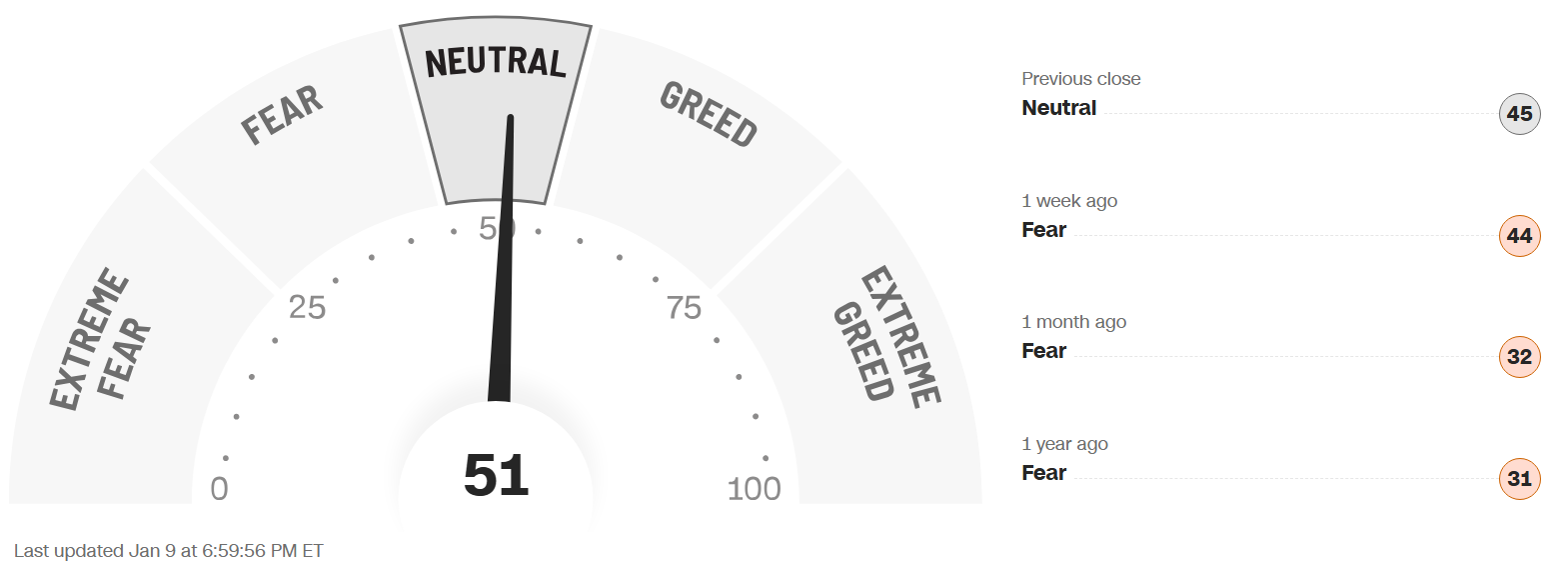
The Fear & Greed Index (found on cnn.com) is one of the easiest indicators to use to determine current market emotion. This simple to read gauge, highlighted in our publication When to Buy and When to Sell: Combining Easy Indicators, Charts, and Financial Astrology (available on Amazon), is measured in a range from 0-100, and currently reads 51 as of the close on Friday, January 9, 2025.
This figure moved squarely into the Neutral level, after rising 6 points from last week’s close of 45, as markets gyrated but finished in the green. This was reflected in the S&P 500, as it rose about 108 points, from 6,858 to 6,966, as volume started to reach normal levels by weeks end.
The 4 major indexes (S&P 500, Nasdaq, Dow Jones Industrial, and Russell 2000), internal bullish sentiment, regarding their 200-day moving averages, has reversed again, as they increased to the mid to high 60’s% range, with the DIA now at 83%, in a broadening market. Each index’ shorter-term 20 and 50-day MAs have jumped as well, helping to raise the 200 MAs. The seasonal strength of December (a month where fund managers alter their portfolios to buy leading stocks) was mixed, with a short (and early), Santa Claus Rally, during the 5-day period from Thursday, December 18 through Wednesday, December 24, resulting in an increase of 3.1% on the S&P. Technically, this rally usually occurs during the last 5 trading days of the year, and first 2 of the new year (which were very strong) and averages a gain of 1.3%. The January Effect is now in play when “new” money traditionally is added to pensions and 401k’s, as well as underperforming stocks, such as small caps (IWM), which surged this week.
The “Risk-On” sentiment returned this week as well, as the Nasdaq spiked on Wednesday and Friday, though it dipped heavily on Thursday, continuing its inconsistency of late. 10-year bond yields remained stubborn, closing the week at 4.17%, basically unchanged from last week’s close of 4.19%, continuing to suggest the bond market is not quite convinced that the economy is in good shape. Yields on long-term bonds are likely to stay elevated until that sentiment changes.
The 7 internal factors used to formulate this gauge are listed on the screen (below):
Market Momentum – (S&P 500 vs its 125-day moving avg) = GREED
Market Volatility (measured by the VIX) = NEUTRAL
Put to Call Ratio 5-day avg. (# of Puts (bearish) vs Calls (bullish) = EXTREME FEAR
Stock Price Strength (# of new 52-week highs vs new 52-week lows) = NEUTRAL
Stock Price Breadth (# of shares rising vs falling on NYSE) = FEAR
Safe-Haven Demand (which measures stocks vs bonds) = FEAR
Junk Bond Demand (non-govt. bond yield spread) = EXTREME GREED
This week 4 of these 7 factors changed levels, as the momentum categories improved with a broader rally, though volatility remained very low. The Put to Call Ratio continues to reflect Fear sentiment, suggesting more possible gains on the horizon. Finally, Safe-Haven Demand, remained at Fear levels, another sign of uneasiness.
The VIX, measured by Market Volatility, oscillated a bit during the week, but closed at the same level, 14.5, as market volatility remains low. The crucial “20” level, has not been approached since November 24, and, as noted the last few weeks, the gauge remains at low levels where a reversal is probable. Look for a likely rise in the volatility in the near future.
News this week focused on lower-than-expected job creation and steady unemployment, with no real significant reaction. Overall mixed manufacturing and housing results, as well as global tensions, caused the beginning of the week surge (new money entering at the new year) to temper a bit. There was also divergence and sector rotation that did the same. A new earnings season is also upon us, which may shift some sector sentiment. Finally, the U.S. Dollar, Oil, and Gold/Silver all moved up, which is rare, further signifying indecision with investors. Watch for continuing shifts and possible increased volatility.
Additionally, we have now officially entered the 2nd year of the Presidential Cycle, known as the Mid-Term Year, which has historically posted the worst returns of the 4-year cycle, at least leading up to the elections. Please see our Did You Know – About the Mid-Term Election Year blog, dated 12-27-25 for more details.
Astrologically, Capricorn season (ruled by the planet Saturn) continues through January 19. Please see our recent Sign Language – Capricorn blog, dated 12-5-25 for full details. As the Sagittarius/Jupiter optimism and expansion of Sagittarius season (usually resulting in favorable market conditions), has faded, they have been tempered by Saturn’s challenging energies.
The planet Mercury, entered the sign of Capricorn on Thursday, January 1 (through Jan 19), resulted in lower volatility, as expected, as its most recent retrograde is well behind us. However, the next Mercury Retrograde occurs from February 26 through March 22, which will likely coincide with the increased volatility we have discussed.
The planet Venus, is also transiting Capricorn (Dec 24 - Jan 16), after exuding holiday cheer during its stay in Sagittarius, symbolized by the increase in retail spending, though it was reported that only the top 10% of the income earners were responsible for 50% of the holiday spending activity, and the Capricorn/Saturn influence has tempered that enthusiasm.
The planet Mars is also in the midst of a Capricorn transit (Dec 14 – Jan 22), theoretically reducing over-aggression, and rewarding hard work and persistence. As previously noted, Mars in Sagittarius symbolized aggressive gains in the short-term, however, the Saturn (ruler of Capricorn) energies have created a few challenges and slowed Mars down (please see our Trader Transits - Mars square Saturn blog, dated 11-29-25). Please also note that all 3 of these planets will form conjunctions with the planet Pluto between the 19th and 27th of January, which is discussed in our Sign Language – Aquarius blog, dated 1-6-26.
The planet Jupiter remains in retrograde in the sign of Cancer (until March 11), and as previously discussed, Jupiter has very powerful expansive energies, which may weaken a bit for the time being.
Finally, the planet Uranus, which is currently in retrograde until February 4, remains in the sign of Taurus (money), and will not return to Gemini until April, 2026. This 6-month re-visit to the sign of money (ruled by Venus), could create more shocks to the markets, in either direction, so beware. Please review our Planet Power – Uranus Retrograde blog, dated 8-27-25 for further details. The January Effect, noted above, in our publication and previous blogs, could also result in a sudden reversal in small caps (the IWM index), as often occurs in this month.
Leading sectors, with over 50% of stocks trading over their 200-day MAs, include Financials (always needed for bullish markets), Healthcare, and Industrials, while Energy has continued to spike shorter-term. Real Estate and Consumer Staples continue to lag, as affordability is a big issue. The recent Utilities decline is mainly a result of the low VIX, as they are a safe play in more volatile market conditions. Sectors of the technology industry that are likely to continue their advance into the future include AI, robotics, quantum computing, and space development (with Pluto positioned in Aquarius, and Uranus in Gemini for many years to come – when it returns in April), but will experience pullbacks along the way.
Gold (ruled by the Sun), and Silver (ruled by the Moon), were very volatile this week, but both again ended the week with gains. The Gold to Silver Ratio (covered in our publication), declined again, closing at 56.3, compared to last week’s close of 59.4, remaining very low, suggesting gold may be a better “value” buy at the current time. Both remain good buys after pullbacks (which they were due for) in the current economic conditions, as central banks continue to buy, and Safe-Haven investments remain popular. Bitcoin (ruled by Uranus) dipped slightly this week, and remains skittish, as the Uranus retrograde is nearing its end.
***As always, this information is not intended to be financial advice, or any specific buy or sell recommendation, but rather a guide to assist the reader in some further understanding of current economic conditions/movements in the sky, and how they can affect moods, behaviors, world events, and financial markets.