FEAR & GREED INDEX 37
Weekly Update
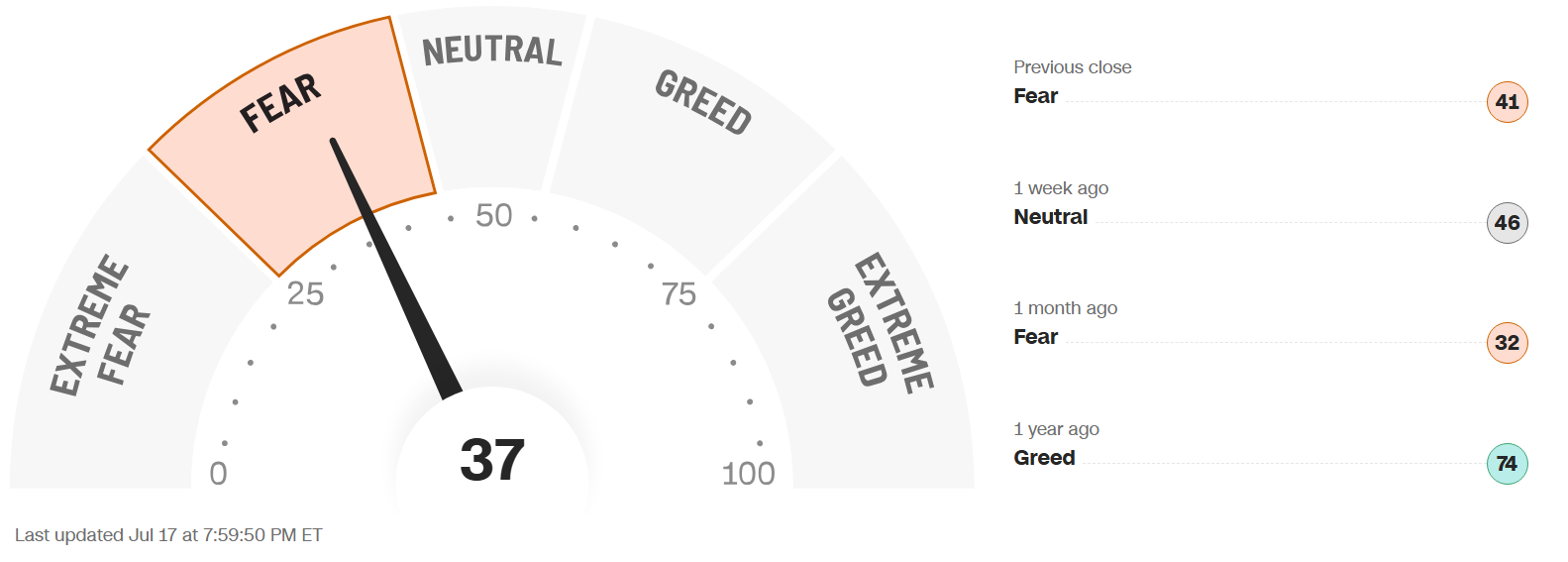
The Fear & Greed Index (found on cnn.com) is one of the easiest indicators to use to determine current market emotion. This simple to read gauge, highlighted in our publication When to Buy and When to Sell: Combining Easy Indicators, Charts, and Financial Astrology (available on Amazon), is measured in a range from 0-100, and currently reads 37 as of the close on Friday, July 17, 2026.
The gauge slid back from Neutral to Fear by the end of the week, slipping 12 points from last week’s close of 49. This was reflected in the S&P 500, which declined 116 points, from 7,575 to 7,459, despite a positive beginning to earnings season. Technology was the culprit as semi-conductors continued their slide after a massive run-up.
The 7 internal factors used to formulate this gauge are listed on the screen (below):
Market Momentum – (S&P 500 vs its 125-day moving avg) = FEAR
Market Volatility (measured by the VIX) = NEUTRAL
Put to Call Ratio 5-day avg. (# of Puts (bearish) vs Calls (bullish) = FEAR
Stock Price Strength (# of new 52-week highs vs new 52-week lows) = FEAR
Stock Price Breadth (# of shares rising vs falling on NYSE) = EXTREME FEAR
Safe-Haven Demand (which measures stocks vs bonds) = FEAR
Junk Bond Demand (non-govt. bond yield spread) = FEAR
This week, 4 of these 7 factors changed levels, as Momentum categories all dropped to Fear levels. The all-important Put to Call Ratio flipped yet again, from Greed to Fear after turning positive last week. Safe-Haven Demand also dropped back into Fear territory with the steady strength of the U.S. Dollar.
The longer-term major indexes’ 200-day MAs (Moving Averages) internal sentiment remains in the bullish zone, but slightly lower at 57% (58% last week), while shorter-term MAs dropped a bit to 52% (20-MA)/56% (50-MA). Leading sectors fluctuated again as well, with the continued “Sector Rotation.” Energy and Financials (always important for a bullish market) remained strong, while Infotech and Utilities weakened. Keep in mind that the “rotation” is better for the market than liquidation to cash or turning to bonds in a “flight-to-quality.”
The “Risk-On” sentiment waned this week with the “tech wreck”, as markets remained difficult to swing trade. The VIX, (market volatility), closed higher (as technology stocks fell), ending up 3.7 points, at 18.7, vs last weeks close of 15.0. As we often note, any break-through of the crucial “20” mark suggests a pullback, so keep an eye on this gauge. The recent intraday volatility continued as well, with frequent reversals. 10-yr bond yields dropped slightly to 4.45%, from last week’s close of 4.56%, as interest rate policy uncertainty continues. Earnings season has begun again, with positive projections for the 2nd Quarter of a 23% average increase, which will certainly start to move some stocks based on confirmation or disappointment.
Economic news this week focused on the inflation gauges CPI (Consumer Price Index) and PPI (Producers Price Index) whose readings for June were both much better than expected, especially with lower oil prices. This can, and has begun to change, with the military conflict ramping up again this week. Consumer Sentiment also reported its highest level since February, though that could fall for the same reason if this week’s higher gas prices persist. Real estate was negative regarding pending home sales and new mortgage applications, though building permits/housing starts rose.
Astrologically, Cancer season (home, emotion), comes to an end on Tuesday, July 21, which is normally a strong performing period for stocks. We will now transit into Leo season (self, leadership), a fixed, fire sign, known for more weakness in market performance. Please review our Sign Language – Leo blog, dated 7-8-26 for more details.
Current shorter-term transits/aspects of note continue to include the Mercury Retrograde in Cancer (through this Thursday, July 23), which traditionally results in reversals concerning the technology industry, often to the downside. The recent Mars conjunction with the planet Uranus (in Gemini) energies kicked in a little early, and has continued through the retrograde, with many sudden, intra-day reversals (Uranus). Please review our recent Trader Transits – Mars conjunct Uranus blog, dated June 22, and previous Mercury Retrograde blogs for more information. The planet Venus has now moved on to the sign of Virgo (through Aug 6), shifting some focus from the self (Leo) to a more critical, meticulous, and selective (Virgo) market in the short-term. As is typical of Virgo, the “loved” stocks will flourish, while the “hated” will be punished, with little in between. This coincides with the beginning of “earnings season,” which usually distinguishes the strong and weak companies. Leading company IBM was a perfect example of this concept, as it was punished 25% after a disappointing earnings report on Tuesday night.
Longer-term, the planet Jupiter moved into the sign of Leo two weeks ago, where it will remain until July 26, 2027, highlighting fashion, self-pleasing products, and travel (signified by the Consumer Discretionary sector), as well as leadership, defense, and gold. Stocks in that sector had been beaten down over the past several months, but have shown improvement (as expected), which would continue along with rising consumer sentiment, though Venus’ influence has now moved out of Leo. Please refer to our Trader Transits – Jupiter in Leo blog, dated 6-12-26, for further information. Keep in mind that travel-related stocks are also sensitive to oil prices, which are vulnerable to the military conflict status (or “perceived” status). Also, as discussed heavily in recent months, Uranus (sudden, unexpected events/high technology) will remain in the sign of Gemini (communications, transportation, advanced technology) until 2033. Uranus’ energies have been on full display of late, with quick, unexpected reversals, and, as we’ve also mentioned in the past several weeks, do not be “surprised” if this type of market action continues with these other planetary transits. Please also review our Trader Transits – Uranus in Gemini blog, dated 3-30-26, for more details.
As we continued to stress, sectors of the technology industry that are likely to continue their advance into the future include AI, robotics, quantum computing, and space development, with both Pluto positioned in Aquarius and Uranus in Gemini, for many years to come, though they will experience pullbacks along the way.
Gold (ruled by the Sun), and Silver (ruled by the Moon), fell throughout the week, with steadiness in the U.S. Dollar. There are a lot of rumors about a “reset” concerning gold, and it may be better to “wait and see” regarding new positions. The Gold to Silver Ratio closed at 71.8, a 3-point rise from last week’s close of 68.8, remaining rather neutral. As we continue to stress, both metals remain good buys after pullbacks, so long as central banks continue to buy, and Safe-Haven investments remain popular, which is expected.
Finally, Bitcoin (ruled by Uranus) seems to have found a bottom, hopefully, and is currently consolidating. Its Fear & Greed Index closed at 33, vs last week’s close of 32, basically unchanged, after a recent bounce. As we mentioned a few weeks ago, this beaten down sector was due for a rise as it had reached a probable buying opportunity.
***As always, this information is not intended to be financial advice, or any specific buy or sell recommendation, but rather a guide to assist the reader in some further understanding of current economic conditions/movements in the sky, and how they can affect moods, behaviors, world events, and financial markets.